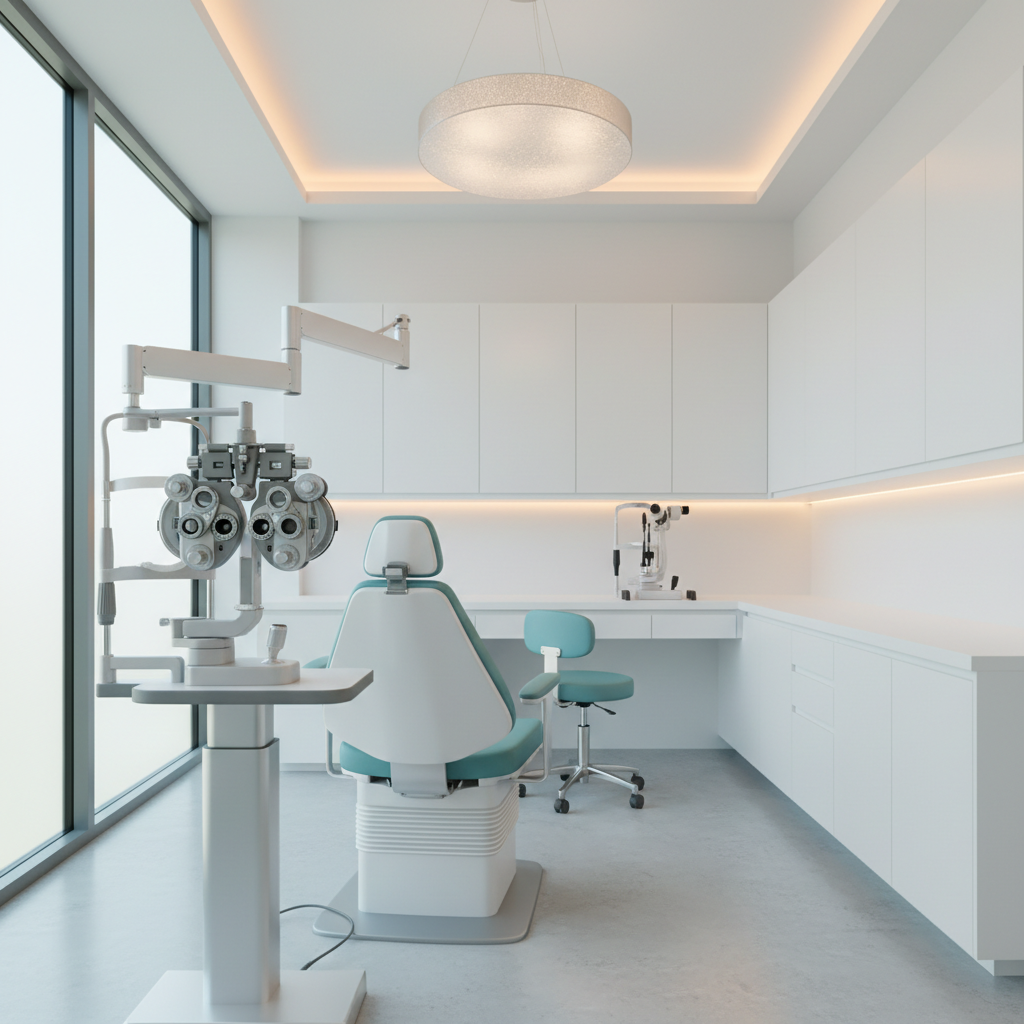
Optical Exams for Every Age, Eye, and Prescription
Whether it is your first exam, a contact lens fitting, a check for your kids, or the regular visits that matter more after 40, this guide walks through the whole appointment in plain English. What gets checked, what it commonly costs, and what the prescription in your hand actually says.
- Every test in a comprehensive exam, explained
- Contact lens, pediatric and diabetic exam differences
- How often to go, by age and risk
- Costs, insurance, and reading your prescription
Inside the exam room
What an optical exam actually covers
A comprehensive optical exam does two different jobs in one appointment. The first is the one everyone expects: measuring how well you see and working out the prescription that corrects it. The second is quieter and arguably more important: a medical inspection of the health of your eyes, front to back.
That second job matters because the diseases that do real damage, glaucoma and retinal disease chief among them, tend to develop without symptoms. You cannot feel rising eye pressure, and vision loss from glaucoma starts at the edges where you will not notice it. A good exam is designed to find these problems while they are still treatable.
The core sequence is remarkably consistent from office to office. Expect the tests below, roughly in this order, with a health history conversation woven through.
Why dilation happens
Dilating drops widen your pupils so the doctor can see the whole retina and optic nerve instead of a keyhole view. The trade-off is a few hours of blurry near vision and light sensitivity. Retinal photography can supplement the view without drops, but when your doctor asks to dilate, it is because the wide view is worth having.
- Visual acuity
- Reading letters on a chart, one eye at a time, to measure how sharply you see at distance and up close. This is where the familiar 20/20 notation comes from. It is the baseline every other measurement builds on.
- Refraction
- The instrument with all the lenses, called a phoropter, and the famous question: which is better, one or two? By flipping lens choices, the doctor dials in the exact prescription that focuses light correctly on your retina.
- Slit lamp exam
- A bright, thin beam of light and a microscope, used to inspect the front of the eye layer by layer: eyelids, lashes, cornea, iris, and lens. This is where dry eye, corneal scratches, and early cataracts show themselves.
- Tonometry
- A measurement of the pressure inside your eye, taken with a quick puff of air or a gentle instrument touch after numbing drops. Elevated pressure is a key risk factor for glaucoma, which steals peripheral vision without any warning you would notice.
- Retinal exam
- A look at the back of the eye: the retina, the macula that handles your central vision, the optic nerve, and the blood vessels. This is where diabetic changes, macular degeneration, and retinal tears are found.
- Function checks
- Smaller tests woven through the visit: how your pupils react, how your eyes move and work as a team, your side vision, and sometimes color vision. Each one screens a different part of the visual system.
Not all exams are the same
Types of optical exams, and which one you actually need
The word "eye exam" covers everything from a thirty-second acuity screening at the DMV to a full dilated medical workup. Knowing which one you are booking, and which one you are being billed for, saves both confusion and money.
Comprehensive exam vs vision screening
A vision screening, the kind done at school, at work, or at the DMV, checks one thing: can you read the chart? It catches some problems and misses many others entirely, because nobody looks at the eye itself. A comprehensive exam includes the refraction plus the full health inspection described above. Passing a screening tells you that your distance acuity was adequate that day. It does not tell you that your eyes are healthy.
Diabetic eye exams
Diabetes damages the small blood vessels of the retina, and the damage is treatable when caught early. That is why people with diabetes are advised to have a dilated retinal exam regularly, typically every year, even when their vision feels fine. These visits are medical care rather than routine vision care, which matters for insurance: they are generally billed to medical insurance, and your eye doctor reports findings back to the physician managing your diabetes.

Contact lens exams
Everything in a comprehensive exam, plus a fitting: measurements of your cornea's curvature, an evaluation of your tear film, trial lenses assessed on the eye, and usually a follow-up visit. The fitting is why contact lens exams cost more, and why the result is a separate prescription that specifies lens brand, material, curve, and diameter. A glasses prescription cannot be converted into a contact lens prescription, because it says nothing about how a lens fits your eye.

Pediatric exams
Children rarely announce that they cannot see well, because they assume everyone sees the way they do. Pediatric exams use age-appropriate methods, shapes and pictures instead of letters, and objective instruments that measure the eye without needing answers at all. The stakes are real: conditions like amblyopia (a "lazy eye") respond far better to treatment in early childhood, and undiagnosed vision problems are a classic hidden cause of struggles at school.
DMV and occupational vision tests
Driver licensing and many jobs, from commercial driving to aviation to law enforcement, require a vision test against a defined standard. These are screenings with a pass mark, not health exams. If you fail one, the usual next step is a comprehensive exam and an updated prescription, after which most people pass on the retest. If you need a form signed for an employer or licensing agency, mention it when you book so the office schedules the right visit.
Risk factors shorten the interval
Diabetes, a family history of glaucoma or macular degeneration, a strong prescription, previous eye surgery or injury, and medications with known eye effects all move you to a more frequent schedule, usually yearly and sometimes more often. Contact lens wearers are typically seen yearly regardless, because the lenses themselves need monitoring and the prescription expires.
The schedule
How often should you have an optical exam?
Recommendations vary a little between professional bodies, and your own doctor's advice should win, because it accounts for your eyes specifically. As general guidance for people without symptoms or risk factors:
| Stage of life | Commonly recommended |
|---|---|
| Infants & preschoolers | A first assessment in infancy, another in the preschool years, and an exam around school entry. Pediatric screenings at well-child visits in between. |
| School-age kids & teens | Regular exams through the school years, commonly every year or two, and promptly whenever grades, sports, or squinting suggest a change. |
| Adults 20 to 39 | A full exam at least every couple of years, yearly if you wear contacts or notice changes. |
| Adults 40 to 64 | A comprehensive baseline around 40, when presbyopia and early disease start appearing, then every one to two years. |
| Adults 65 and up | Yearly exams, since cataract, glaucoma, and macular degeneration all become more common with age. |
| Diabetes or family history | Yearly at minimum, on whatever schedule your eye doctor and physician set together. |
One habit worth keeping: do not wait for the calendar if something changes. Sudden flashes, a curtain of floaters, eye pain, or a drop in vision are same-day phone calls, not items for next year's exam.
Paying for it
What an optical exam costs, and who pays
Exam fees vary widely by region, by setting, and by what the visit includes, so treat any single number you see advertised as a starting point rather than the bill. What you can predict is the structure of the cost. It is built from a few consistent pieces.
What drives the price
- The base exam fee, which is commonly lower at retail chains and optical departments than at independent practices.
- A contact lens fitting fee, added on top when you want a contact lens prescription.
- Optional imaging, such as retinal photos, sometimes offered for an extra charge.
- Whatever glasses or lenses you buy afterward, which is a separate purchase you are never obligated to make where you were examined.
Vision insurance vs medical insurance
Vision plans are built for routine care: they typically cover an exam on a set schedule, often yearly, plus an allowance toward glasses or contacts. Medical insurance takes over when the visit is about a medical problem: an infection, an injury, dry eye treatment, glaucoma monitoring, or a diabetic eye exam. The same office may bill either one depending on why you came in and what the doctor finds, which is why the front desk asks for both cards. Medicare follows the same logic: it generally does not pay for routine refractions, but medically necessary eye care is covered.
Retail chains vs independent ODs
Both employ licensed optometrists, and a good exam is available in both settings. Retail and warehouse-club locations compete on posted price and convenience, and appointments tend to be shorter. Independent practices generally offer longer appointments, more continuity with the same doctor year over year, and often a wider range of medical eye care in-house. If your eyes are healthy and your prescription is simple, the difference may not matter much. If you have risk factors or a complicated history, continuity starts earning its keep.
A fair-comparison tip
When you compare prices between offices, ask each one the same question: what is the total for a comprehensive exam, with the contact lens fitting if you need one, and does it include a copy of my prescription? The last part is a trick question. In the US you are entitled to your prescription either way, at no extra charge.
Decode the paperwork
What your prescription means
The slip you walk out with looks like code, but it reads easily once you know the abbreviations. All the numbers are in diopters, a unit of lens power, and minus means correcting nearsightedness while plus means correcting farsightedness.
| Abbreviation | What it means |
|---|---|
| OD / OS | Your right eye (OD) and left eye (OS), from the Latin. OU means both eyes. |
| SPH (Sphere) | The main lens power. A minus value corrects nearsightedness, a plus value corrects farsightedness. |
| CYL (Cylinder) | Extra power that corrects astigmatism, an eye that focuses unevenly in different directions. Blank means you have none worth correcting. |
| Axis | A direction from 1 to 180 degrees telling the lab which way to orient the cylinder correction. Meaningless without the CYL value it belongs to. |
| ADD | Added magnifying power for the reading portion of bifocal or progressive lenses, the standard fix for age-related near blur (presbyopia). |
| PD | Pupillary distance, the millimeters between your pupils, used to center the lenses in front of your eyes. Often not written on the slip by default. Ask for it, especially if you plan to order glasses online. |
| Prism | A less common correction that shifts the image to help eyes that do not aim together, prescribed for certain kinds of double vision. |

Your prescription belongs to you
US federal rules require your prescriber to hand you your glasses prescription after the refraction, and your contact lens prescription once the fitting is complete, without your asking and without an extra fee. You can fill it anywhere: the same office, another optical shop, or online.
Expiration dates
Glasses prescriptions expire on a schedule set by state law, commonly one to two years. Contact lens prescriptions run at least one year under federal rules unless your doctor documents a medical reason for a shorter term. The expiration is not bureaucracy for its own sake. It is the mechanism that brings you back for the health check.
Glasses and contacts are different documents
A contact lens sits on the eye rather than in front of it, so its prescription includes fit parameters and a specific brand and material. One cannot be converted into the other, and a retailer cannot legally fill contacts from a glasses slip.
The three O's
Choosing where to go, and who you'll see
Three professions share the word "optical," and they do different jobs. Knowing which is which makes booking the right appointment simple.
Optometrist (OD)
Primary eye care
The doctor who performs most routine optical exams. Optometrists examine eyes, prescribe glasses and contacts, and diagnose and manage a broad range of eye conditions, with prescribing authority that varies by state. For most people, an optometrist is the natural home base for eye care.
Ophthalmologist (MD/DO)
Medical & surgical care
A physician who specializes in eyes. Ophthalmologists handle surgery, from cataract removal to retinal repair, and manage complex disease. You typically arrive by referral when an exam turns up something that needs medical treatment, though many also provide routine exams.
Optician
Fitting & dispensing
The professional who turns a prescription into finished eyewear: helping you choose frames, taking fitting measurements, adjusting glasses, and troubleshooting comfort. Opticians do not examine eyes or write prescriptions, so an optician visit never replaces an exam.

Retail chain or private practice?
Choose on what you value. Retail settings win on posted price, evening and weekend hours, and getting exam plus glasses handled in one trip. Private practices win on appointment length, continuity with one doctor, and depth when something medical turns up. There are excellent doctors in both. What you should expect anywhere: a full health check, clear answers to your questions, and your prescription in your hand at the end.
Online vision tests, honestly assessed
Online refraction tests can be a legitimate convenience for a narrow group: healthy adults with mild, stable prescriptions who need a renewal between full exams, where a remote doctor reviews the result. Their hard limit is that no screen can measure your eye pressure or look at your retina. Used as a bridge, fine. Used instead of comprehensive exams for years on end, they leave exactly the silent diseases an exam exists to catch.
Questions worth asking when you book
Is the exam comprehensive or a screening? Is dilation or retinal imaging included, and at what cost? If I wear contacts, what does the fitting add? Do you take my vision plan or bill my medical insurance when needed? Five minutes on the phone makes the visit and the bill predictable.
Common questions
Optical exam FAQ
How long does an optical exam take?
Plan on somewhere between twenty minutes and an hour for the exam itself. A straightforward glasses check at a busy retail location sits at the short end, while a first visit with a full health workup, dilation, or a contact lens fitting runs longer. If your eyes are dilated, add time afterward while the drops take effect and your near vision stays blurry.
Does an eye exam hurt?
No part of a routine eye exam is painful. The air-puff pressure test startles some people but lasts a fraction of a second, and many offices now use instruments that touch nothing at all. Numbing and dilating drops can sting for a few seconds when they go in. That is the extent of it.
What does 20/20 vision actually mean?
It means you can read at 20 feet what a person with normal vision reads at 20 feet. It is a benchmark, not perfection. Some people see better than 20/20, and plenty of eye problems, including early glaucoma and retinal disease, can be present while acuity still measures 20/20. That is exactly why the health portion of the exam matters.
Do I need my eyes dilated every time?
Your eye doctor decides based on your age, health, and risk factors. Dilation gives the widest, clearest view of the retina and optic nerve, so it is standard for first visits, for older adults, and for anyone with diabetes or other risk factors. Many offices also offer wide-field retinal imaging, which photographs the retina without drops. It complements dilation well, but whether it can stand in for it on a given visit is your doctor's call.
Can I drive home after my eyes are dilated?
Dilation blurs near vision and makes bright light uncomfortable for a few hours, sometimes longer if your eyes are light-colored. Many people do drive afterward, especially with sunglasses, but if you are sensitive to glare or have never been dilated before, arrange a ride or plan to wait until the effect fades. The office will give you disposable sun shields if you ask.
Why does a contact lens exam cost more than a glasses exam?
Because it is genuinely more work. A contact lens sits directly on your cornea, so the doctor has to measure the curve and surface of your eye, evaluate your tear film, put trial lenses on, check the fit under magnification, and usually see you again for a follow-up. That fitting work is billed on top of the regular exam, which is why the contact lens prescription is a separate document from your glasses prescription.
What should I bring to an eye exam?
Bring your current glasses and contact lens boxes or packaging, your vision or medical insurance details, a list of medications you take, and whatever you know about your family's eye history, especially glaucoma and macular degeneration. If you have an old prescription, bring that too. Sunglasses are worth having in the car in case you are dilated.
When should my child have their first eye exam?
Professional groups differ on the exact schedule, but the common pattern is a first assessment in infancy, another check in the preschool years, an exam around the start of school, and regular exams through the school years. Pediatricians screen vision at well-child visits and refer when something looks off. Book an exam sooner if your child squints, sits very close to screens, tilts their head to look at things, or complains of headaches with schoolwork.
Can an online vision test replace a real eye exam?
No. An online test can estimate a refraction and, in some situations, help renew a prescription for a healthy adult with a stable, mild correction. What it cannot do is look at your eyes. Glaucoma, retinal disease, and early cataracts develop without symptoms and are found by examination, not by reading letters off a screen. Treat online tests as a convenience between comprehensive exams, never as a substitute for them.
Can an eye exam detect problems beyond my eyesight?
Yes. The retina is the one place in the body where blood vessels and nerve tissue can be inspected directly, so an eye exam can pick up signs consistent with diabetes, high blood pressure, and other conditions, sometimes before a person has any other symptoms. When an eye doctor sees something suspicious, they refer you to your physician. It is one of the quiet arguments for keeping regular exam appointments even when your vision feels fine.
The answers above are general information about how optical exams usually work in the US. They are not medical advice, and your own eye doctor's guidance about your eyes comes first.
Ask a Question
Still wondering about something?
If this guide left a question unanswered, send it through. We read everything and reply in plain English. For anything about your own eyes, symptoms, or treatment, the right person to ask is an eye doctor who can actually examine you. We will say so when that is the honest answer.

Before you book
Which type of exam fits your situation, and what to ask the office when you call.
After your visit
Making sense of your prescription, your options for filling it, and what the follow-up advice meant.
For your family
Kids' first exams, timing for aging parents, and what changes when diabetes is in the picture.